Growth is supposed to feel good. But for most agency owners, every new client comes with the same quiet dread: more accounts to build, more platforms to check, more reports to send, and not enough hours to do it. The obvious fix is to hire. The problem is that hiring is slow, expensive, and risky when margins are already tight.
There is a better way to grow. You can take on more clients with the team you already have. This guide breaks down the five things that cap agency growth and shows you how to fix each one, so you can learn exactly how to scale a digital marketing agency without adding headcount.
Key Takeaways
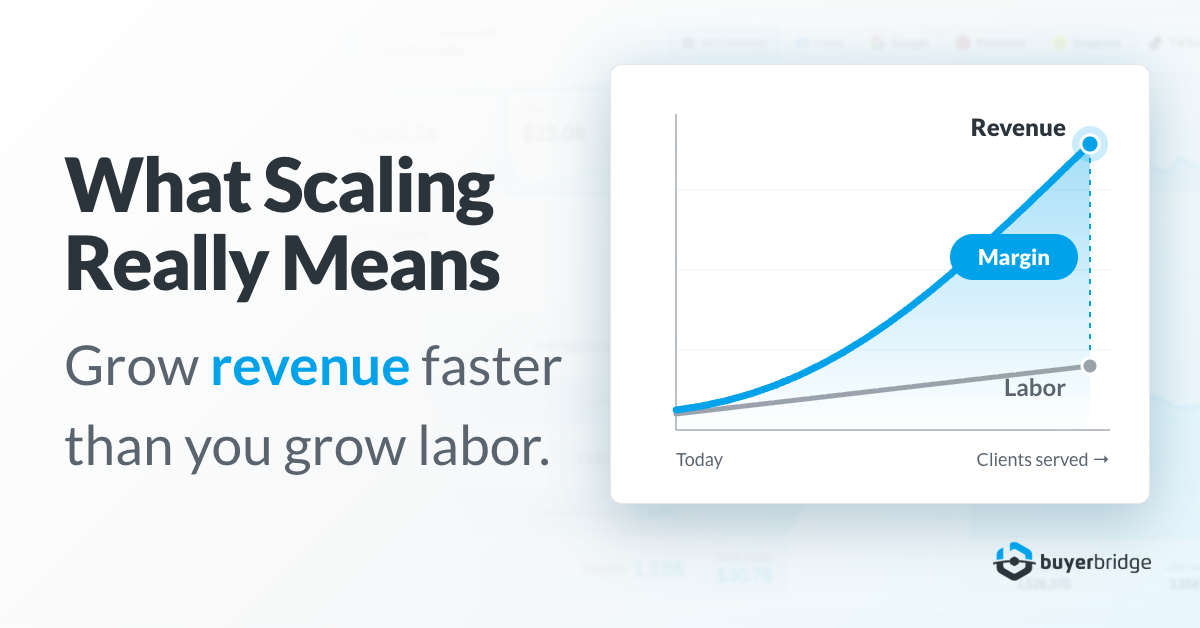
- Scaling means growing revenue faster than you grow labor, not adding clients and staff at the same rate.
- Hiring your way to growth breaks down because each new client adds manual work a new hire can only partly absorb.
- Five bottlenecks cap most agencies: campaign build time, juggling ad accounts, reporting, budget control, and slow onboarding.
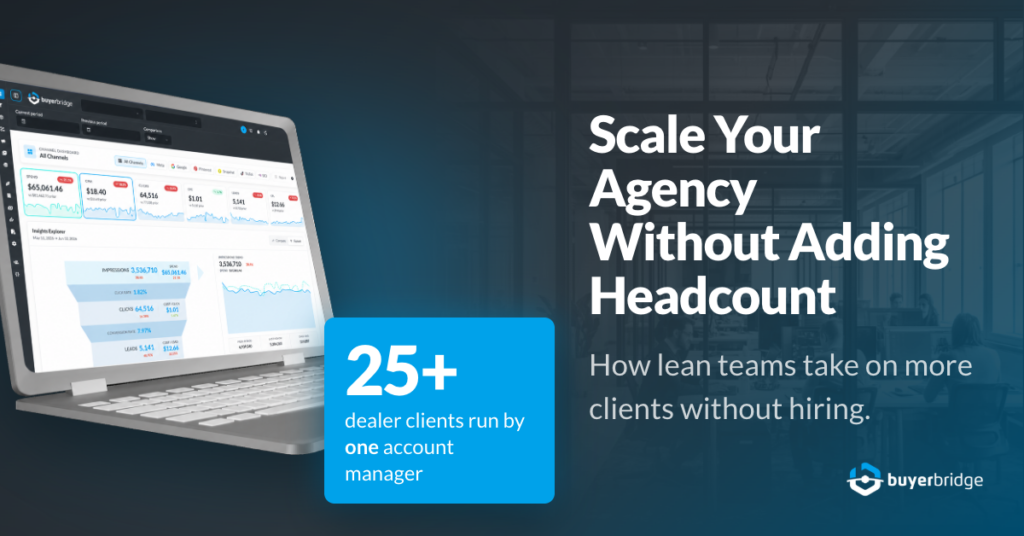
- Automating repetitive ad ops is what lets a lean team manage 25 or more accounts without burning out.
- BuyerBridge helps agencies launch campaigns in minutes, manage every channel in one place, and keep budget under control.
Agency accounts onboarded
Pre-built campaigns in Playbooks
Minutes to launch a campaign
What scaling a digital marketing agency actually means
Scaling is not the same as growing. Growing means adding clients. Scaling means adding clients without adding the same amount of cost, time, and stress. When you grow, your workload rises in a straight line with your client count. When you scale, your revenue climbs while your workload stays flat.
Here is the difference in plain terms. If landing five new clients means hiring two more people, you are growing. If landing five new clients means your current team runs them with a few extra hours a week, you are scaling. The goal is to break the link between more clients and more labor.
For automotive agencies, this matters even more. Your clients expect fresh inventory ads, fast changes, and clear proof that their spend is working. Doing all of that by hand for every rooftop is what keeps agencies stuck. Scaling means finding the parts of that work a machine can do, so your people can focus on strategy and client relationships.
Why hiring your way to growth stopped working
The old agency model was simple: win a client, hire a person, repeat. That math no longer holds. Good ad ops talent is hard to find, slow to train, and costs more every year. And even a great hire spends much of their week on repetitive tasks that do not need a human at all.
Think about where the hours actually go. Building the same campaign types over and over. Logging into five ad platforms. Copying numbers into a report. None of that is strategy. It is busywork that scales with your client count, which means every new hire gets buried in it too.
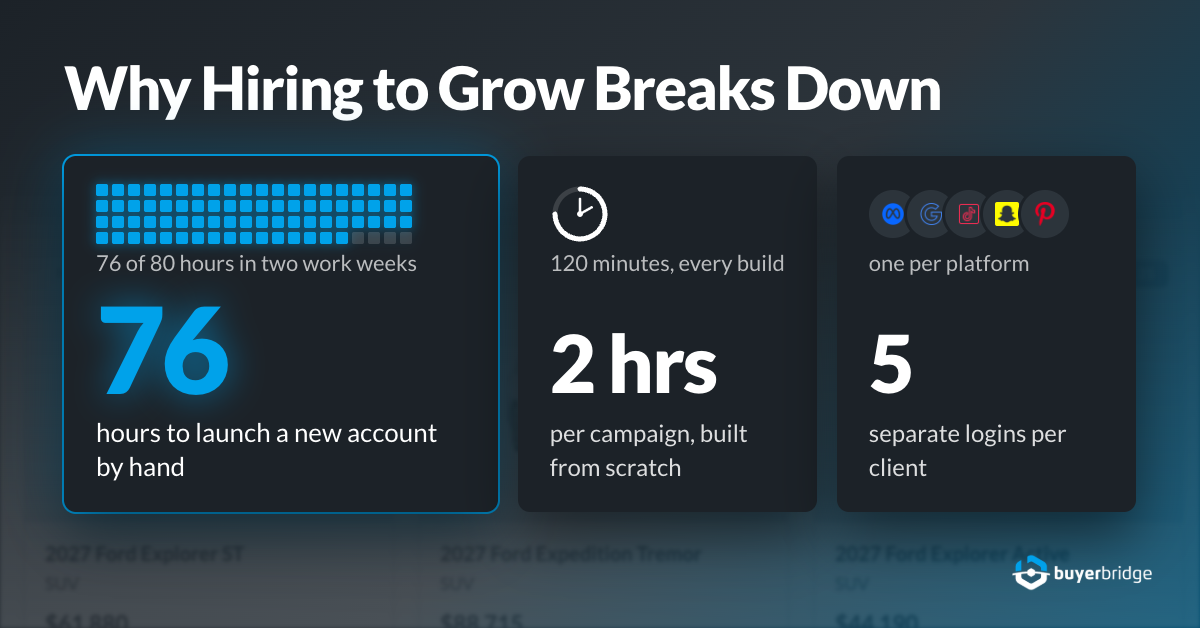
Agencies average 76 hours to launch a new account by hand. Automation cuts that to minutes, not days.
When your growth is capped by how many people you can hire and train, you will always hit a ceiling. The agencies pulling ahead stopped treating headcount as the only lever. They put software on the repetitive work and kept their people on the work that clients actually pay for.
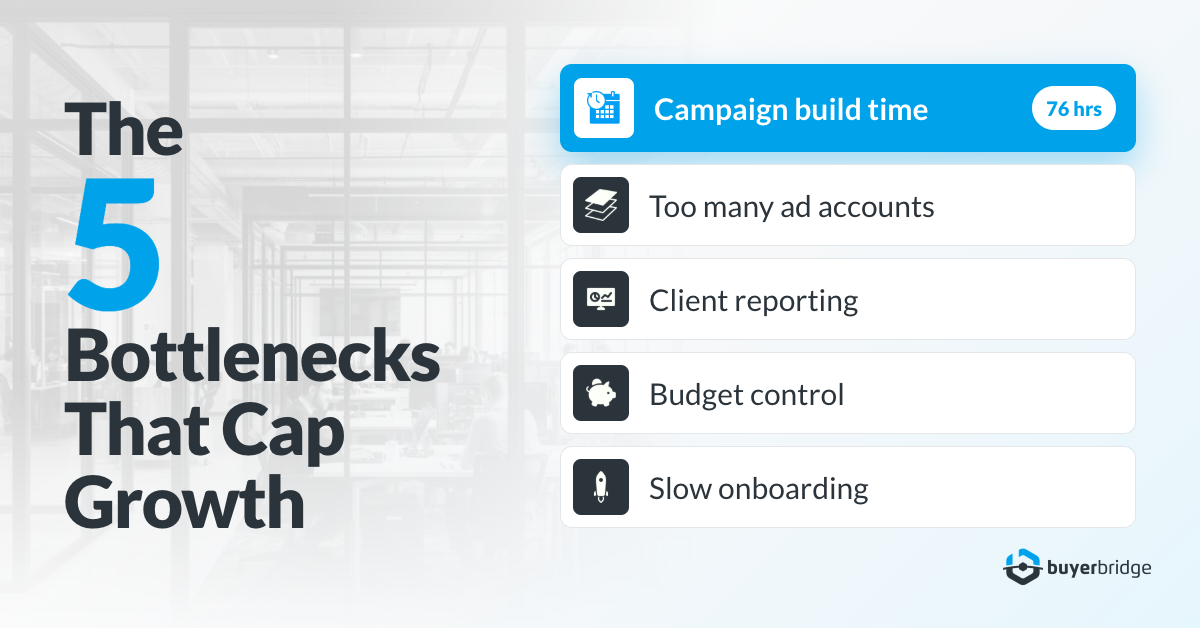
The 5 bottlenecks that cap agency growth
Almost every agency that feels stuck is hitting the same five walls. Name them, and you can fix them one at a time. Here is what caps most agencies as they try to scale:
- Campaign build time. Every new client or inventory push means building campaigns from scratch.
- Too many ad accounts. Meta, Google, TikTok, Snapchat, and Pinterest each live in their own login.
- Client reporting. Pulling and formatting reports across channels eats hours every week.
- Budget control. Platform algorithms spend where they want, not where the client needs.
- Slow onboarding. Each new client takes days to set up before a single ad goes live.
The rest of this guide takes these one at a time and shows the fix for each. The pattern is always the same: find the repetitive part, hand it to automation, and give your team back the hours.
Fix the biggest time sink: campaign build time
Building campaigns by hand is the single biggest drain on an ad ops team. For automotive agencies, it is brutal. You are building inventory ads across makes, models, price bands, and rooftops, then rebuilding them as inventory turns over. Do that for 10 dealer clients and your week is gone.
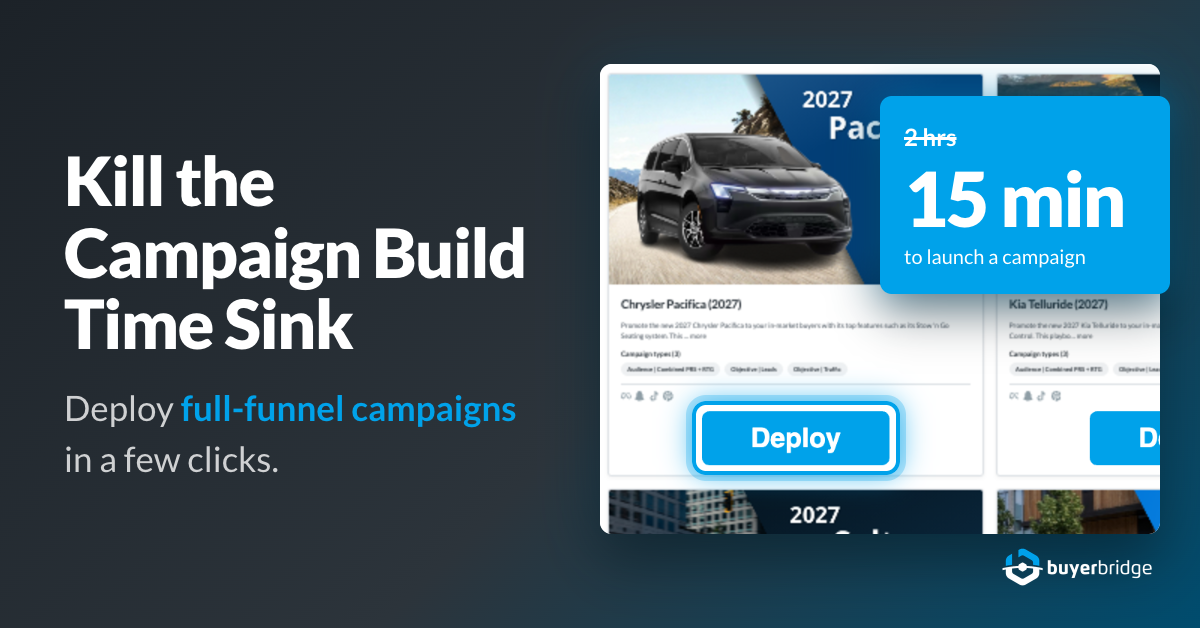
This is where pre-built campaigns change the math. Instead of starting from a blank screen, your team deploys a ready-made, full-funnel campaign in a few clicks. BuyerBridge Playbooks give you 250 or more pre-built social ad campaigns. For automotive, you build a Product Set (a vehicle group like used SUVs under $35K) and attach it to a Playbook. The dynamic inventory campaign launches with spend guardrails already built in.
The result is the difference between hours and minutes. Agencies on BuyerBridge went from spending 2 hours building campaigns to under 15 minutes. Multiply that across every client and every inventory refresh, and you have found the time to take on more accounts without touching your headcount.
Manage every client and channel from one place
The second bottleneck is tab overload. Your team bounces between Meta Business Suite, Google Ads, TikTok Ads Manager, Snapchat, and Pinterest all day. Every switch costs focus and time. Every extra client makes it worse. This is the quiet tax that keeps a team from ever feeling on top of the work.
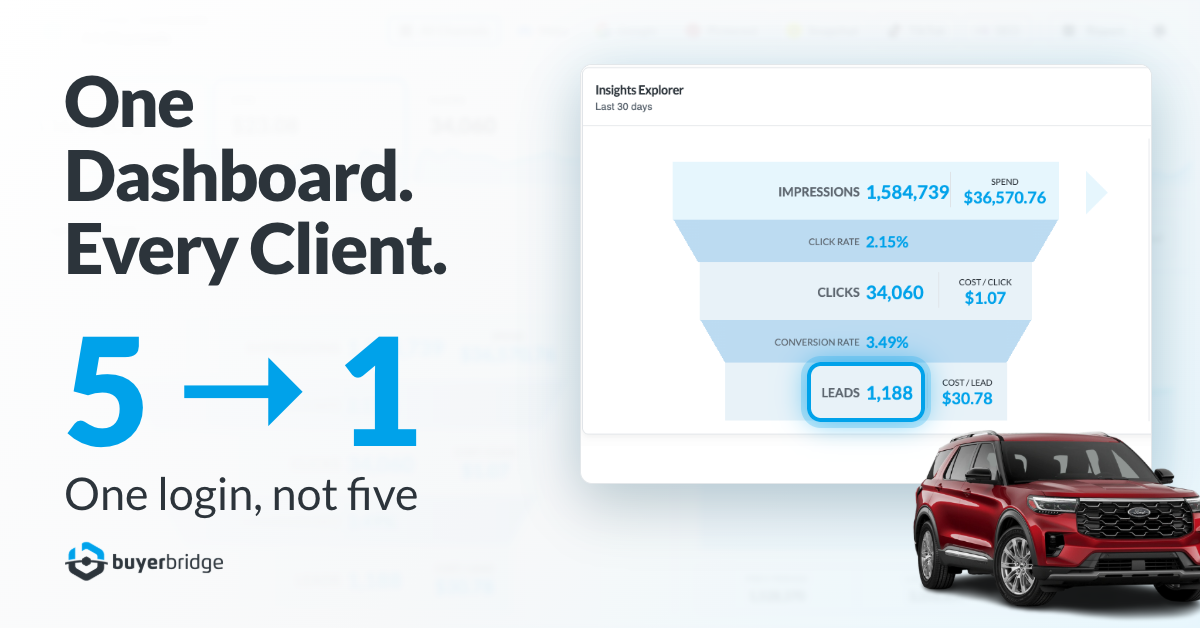
One dashboard fixes it. When you can turn ads on and off, adjust budgets, and check performance across every channel and every client in a single view, the day stops feeling fragmented. Your team stops hunting for information and starts acting on it.
Here is what moving to a single dashboard changes day to day:
- No more logging into five platforms to make one change.
- Every client and every channel visible in one place.
- Faster edits, fewer missed issues, less context switching.
- New team members ramp faster because there is one tool to learn, not six.
Turn client reporting from a time sink into a growth tool
Reporting is where Friday afternoons go to die. Pulling numbers from each platform, dropping them into a template, and formatting it to look clean is hours of work that repeats every month, for every client. It does not grow the agency. It just has to get done.
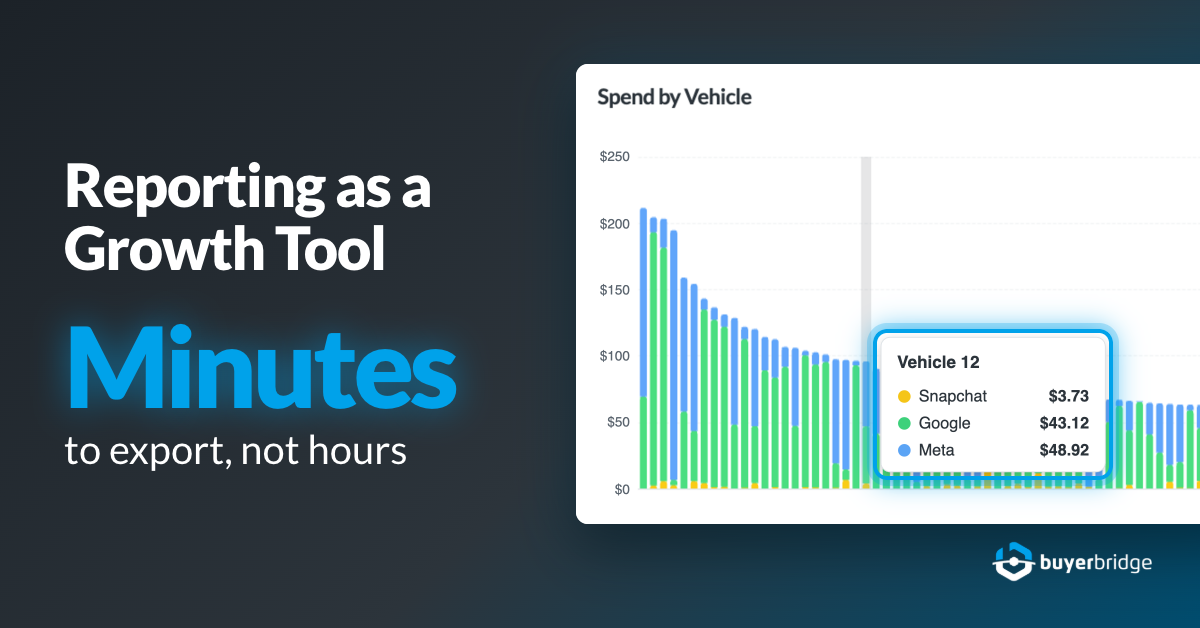
Automated, cross-channel reporting takes that off your plate. Every client’s performance sits in one view, exportable in minutes, and branded as your agency with whitelabel. When the report carries your logo instead of a platform’s, you look like the expert, and the client sees your agency as the source of results.
Reporting done well is not just a time save. It is a retention tool. Clients who clearly see their results stay longer, and agencies that report cleanly get the room to raise scope.
Take back budget control from the algorithm
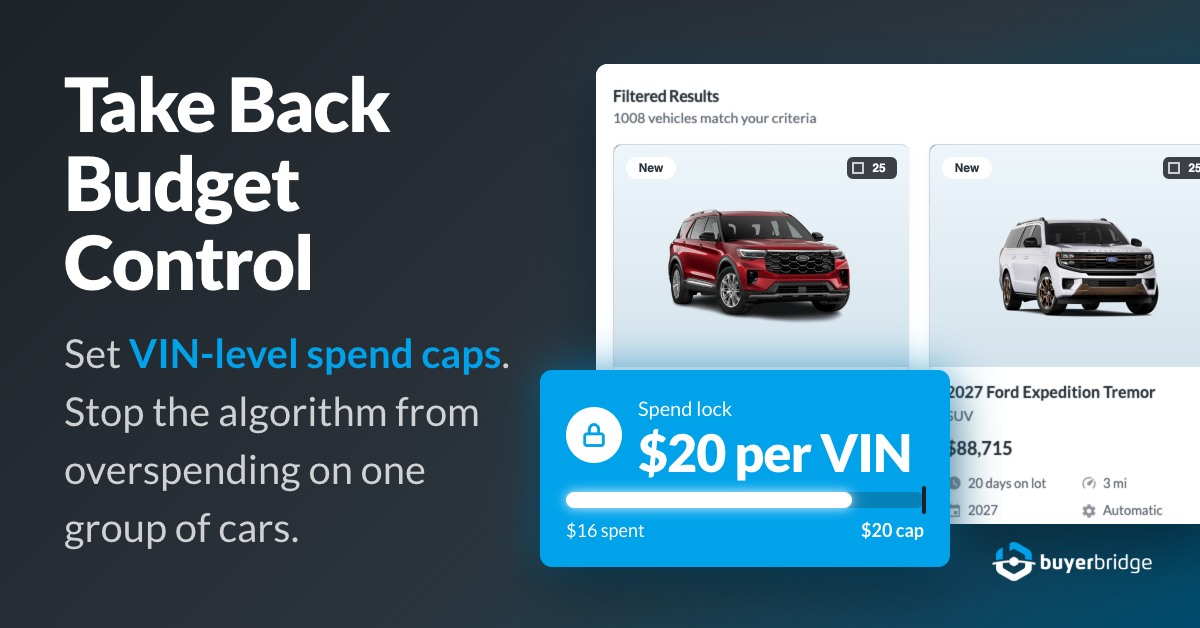
Here is a pain that keeps growing: the ad platforms keep taking control away from you. Meta’s algorithm optimizes for what it wants, not for what your client needs to move. Left alone, it will pour budget into one group of vehicles and starve the rest of the inventory that also needs to sell.
For automotive agencies, that is a real problem. Your dealer does not just need clicks. They need the aging units off the lot. BuyerBridge solves this with VINFlow, the workflow inside Playbooks that adds spend guardrails at the inventory level. You set the caps, and Meta cannot concentrate the whole budget on one group of cars.
That combination is the point. You get the speed of pre-built campaigns and the control of budget caps at the same time. Fast to launch, and smart about where the money goes.
Manual vs automated agency ad ops
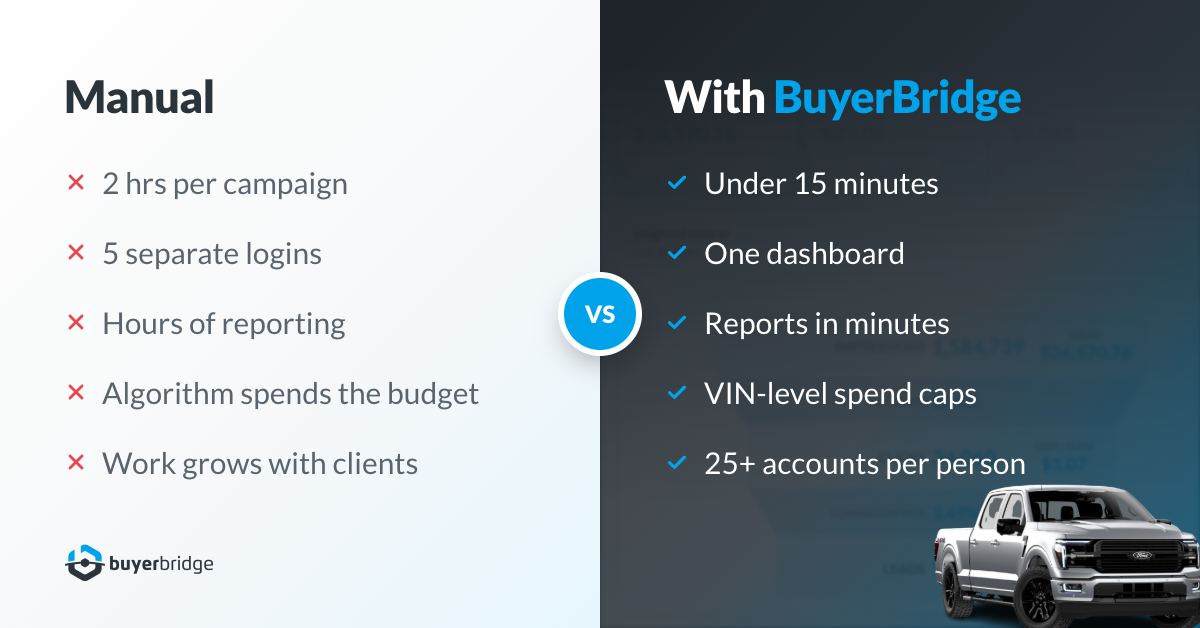
Put the two ways of working side by side and the case for automation is obvious. The manual approach is not just slower. It caps how many clients one person can carry.
| Task | Manual ad ops | Automated with BuyerBridge |
|---|---|---|
| Launch a campaign | 2 hours, built from scratch | Under 15 minutes with Playbooks |
| Manage channels | Five separate logins | One dashboard |
| Client reporting | Hours of copy and paste | Exported in minutes, whitelabeled |
| Budget control | At the mercy of the algorithm | VIN-level spend caps |
| Accounts per person | Limited, work grows with clients | 25 or more with the same team |
The manual column is why agencies feel they have to hire to grow. The automated column is how they scale without it.
Your step-by-step plan to scale without hiring
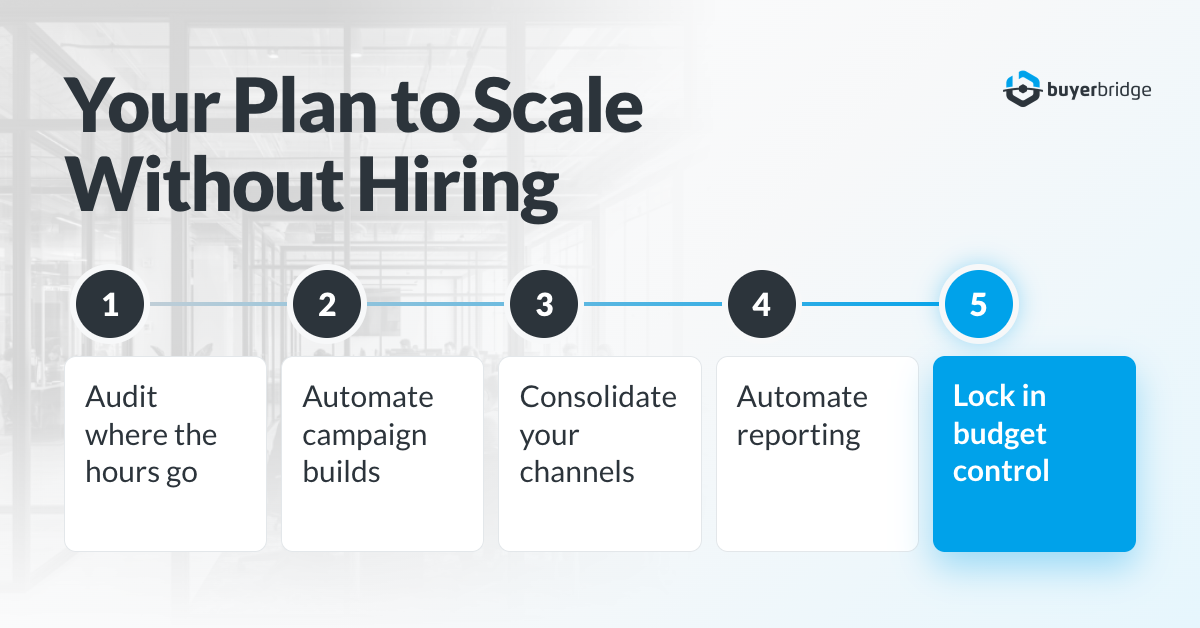
You do not need to fix everything at once. Work through these five steps in order, and each one gives your team back hours you can point at new clients.
- Audit where the hours go. Track one week of ad ops work. Most teams are shocked how much is build time and reporting.
- Automate campaign builds. Replace from-scratch builds with pre-built Playbooks so launches take minutes.
- Consolidate your channels. Move every client and platform into one dashboard to kill tab overload.
- Automate reporting. Switch to cross-channel, whitelabeled reports you can export in minutes.
- Lock in budget control. Set inventory-level spend caps so budget goes where the client needs it.
Do these in sequence and the ceiling on your growth lifts. You stop asking how many people you need to hire, and start asking how many clients you can take on.
Frequently asked questions
How to scale a digital marketing agency without hiring more people?
You scale a digital marketing agency without hiring by automating the repetitive ad ops work that grows with every client. That means using pre-built campaigns instead of building from scratch, managing all channels from one dashboard, and automating client reporting. This frees your existing team to handle more accounts, so revenue grows faster than labor. BuyerBridge is built to automate exactly this work for agencies.
What is the biggest bottleneck to agency growth?
The biggest bottleneck is campaign build time. Building ad campaigns by hand for every client and every inventory refresh consumes the most hours and scales directly with your client count. Automating campaign builds with pre-built Playbooks cuts launch time from about 2 hours to under 15 minutes, which removes the wall that forces agencies to hire in order to grow.
How many ad accounts can one person manage with automation?
With manual ad ops, one person can only manage a limited number of accounts before the repetitive work buries them. With automation that handles campaign builds, multi-channel management, and reporting, a single team member can manage 25 or more accounts. The gain comes from removing busywork, not from working longer hours.
Is automation only useful for automotive agencies?
No. Automation helps any agency managing multiple clients across paid social and search. Automotive agencies get extra value from inventory-specific features like VINFlow spend caps, but the core wins of faster launches, one dashboard, and automated reporting apply to any agency running multi-client ad operations across Meta, Google, TikTok, Snapchat, and Pinterest.
Does automation replace my ad ops team?
No. Automation replaces the repetitive tasks your team should not be doing by hand, like building the same campaigns and copying numbers into reports. It frees your people to focus on strategy, client relationships, and performance, which is the work clients actually pay for. The goal is to make a lean team more capable, not smaller.
Why agencies choose BuyerBridge
- 250+ pre-built Playbooks, so a new client launches in a few clicks instead of days.
- Every channel (Meta, Google, TikTok, Snapchat, Pinterest, and Reddit) in one dashboard.
- VIN-level budget control with VINFlow, so the algorithm cannot overspend on one group of cars.
- White-label, cross-channel reporting your clients actually read.
- Onboarding in under a week, plus matchback reporting that ties ad spend to real sales.
Want to size up your market first? Run a free MarketAnalyzer report.
The bottom line
You cannot hire your way to scale anymore, and you do not need to. Knowing how to scale a digital marketing agency comes down to one move: automate the repetitive work and keep your people on strategy. Put automation on the repetitive ad ops work, and your current team can carry far more clients than it does today. Start with the biggest time sink, campaign build time, and work down the list from there.
If you want to see what that looks like in practice, we can walk you through it. Book a 30-minute demo and we will show you how agencies launch campaigns in minutes and manage every client from one place.
Written by Emily Leasure, Product Marketing Manager at BuyerBridge. Connect on LinkedIn.