
A client asks which channel sold the car. You have four dashboards open and every one of them takes credit. Add the numbers up and you sold the car three times. Marketing attribution is the work of deciding which of those claims is real, and it is the part of the job that quietly decides whether your retainer survives the next renewal conversation.
The awkward part is that the platforms grade their own homework. Each one reports on what it can see, none of them see each other, and in 2026 several of them changed what counts without asking you first. This guide covers what attribution is, what broke this year, which models are worth using, and how to measure across every channel you run so the answer you give the client holds up.
Key Takeaways
- Marketing attribution assigns credit for a conversion to the ads that influenced it, across every channel that touched the buyer.
- Platform-reported marketing attribution double counts, since each platform only sees its own clicks and views.
- Meta narrowed its attribution twice in 2026, so reported results fell while actual results did not.
- Pick the attribution window first. Most model arguments are really window arguments.
- For purchases that close in person, matching real sales back to ad exposure beats any model.
On this page
- What marketing attribution means
- What changed in 2026 and why your numbers dropped
- The four attribution models in plain language
- Pick the window before you argue about the model
- Where attribution data actually comes from
- Attribution when the sale happens in person
- Cross channel attribution across six channels
- Single touch vs multi touch vs matched to sold data
- Why agencies choose BuyerBridge
- Report it so the client believes it
- A monthly marketing attribution routine
- FAQ
Days Meta now credits a view
Ad channels in one reporting view
Industry average cost per vehicle sale, dollars
What marketing attribution means
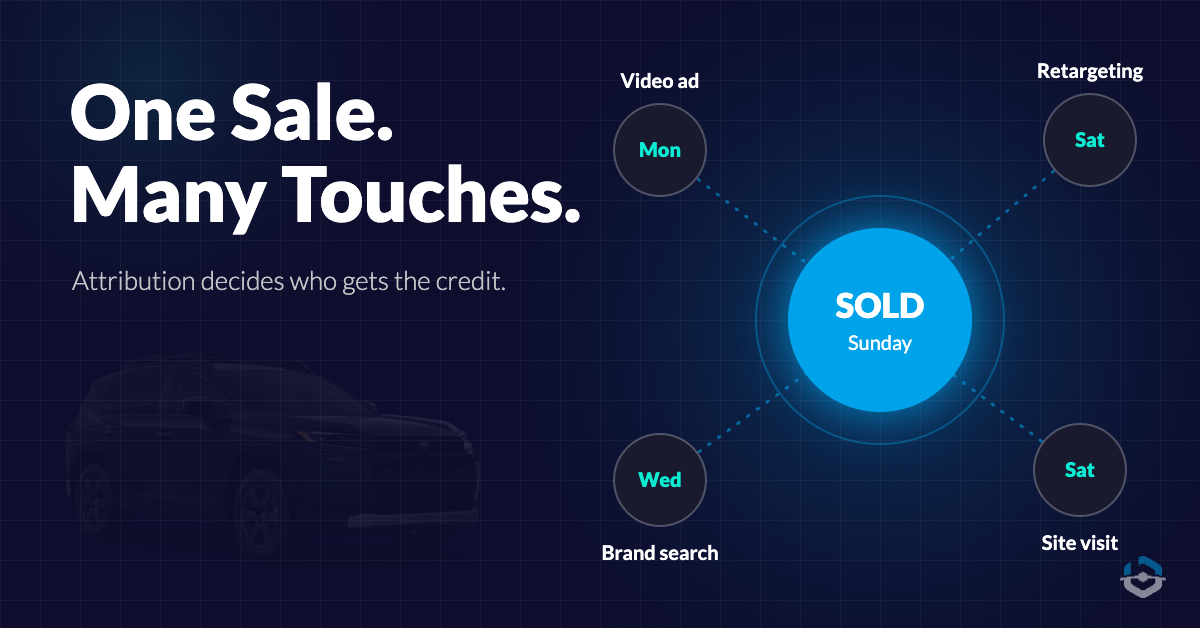
Marketing attribution is how you assign credit for a conversion to the ads and touchpoints that influenced it. Somebody saw a video ad on Monday, searched the brand on Wednesday, clicked a retargeting ad on Saturday, and bought on Sunday. Attribution decides how much of that sale belongs to each step.
Nobody buys anything important on the first touch. That is the whole reason this is hard. If every purchase followed one click you would not need a model, you would need a spreadsheet.
Three things have to be true before any of it works:
- You can see the touchpoints. Views, clicks, and site behavior, captured on every channel you run.
- You can see the conversion. The form fill, the call, or the sale that actually happened.
- You can connect the two. A shared identifier, a matched record, or a documented assumption.
Miss any one of those and you are not doing attribution. You are reading whatever each platform chose to tell you, and each platform has an interest in the answer.
What changed in 2026 and why your numbers dropped
If your reported conversions fell off a cliff this year and you could not explain why, here is the explanation. Meta narrowed what it counts, twice.
On January 12, 2026, Meta retired its 7-day and 28-day view attribution windows, leaving a one-day view window, which it announced on its developer blog. In late March it narrowed clicks too, so only direct-to-site clicks register as clicks, while likes, shares, and saves now get treated as views and inherit that same one-day window. Meta documents how these settings work in its guide to attribution models and attribution settings.
Think about what a one-day view window means for anything with a considered purchase. Nobody watches a truck ad on Tuesday and signs paperwork before Wednesday morning. The sale still happened. The ad still helped. The report just stopped saying so.
Sales held steady while the measurement window shrank. Plenty of agencies spent the spring explaining a decline that was never real.
Two lessons come out of that spring. The first is that platform-reported marketing attribution is a rented number and the landlord can change the terms. The second is that any agency whose entire proof rested on one dashboard had a very bad quarter through no fault of its own.

The four attribution models in plain language
A marketing attribution model is a rule for splitting credit. That is all it is. The industry has made it sound harder than it is, so here are the four you will actually meet, stripped down.
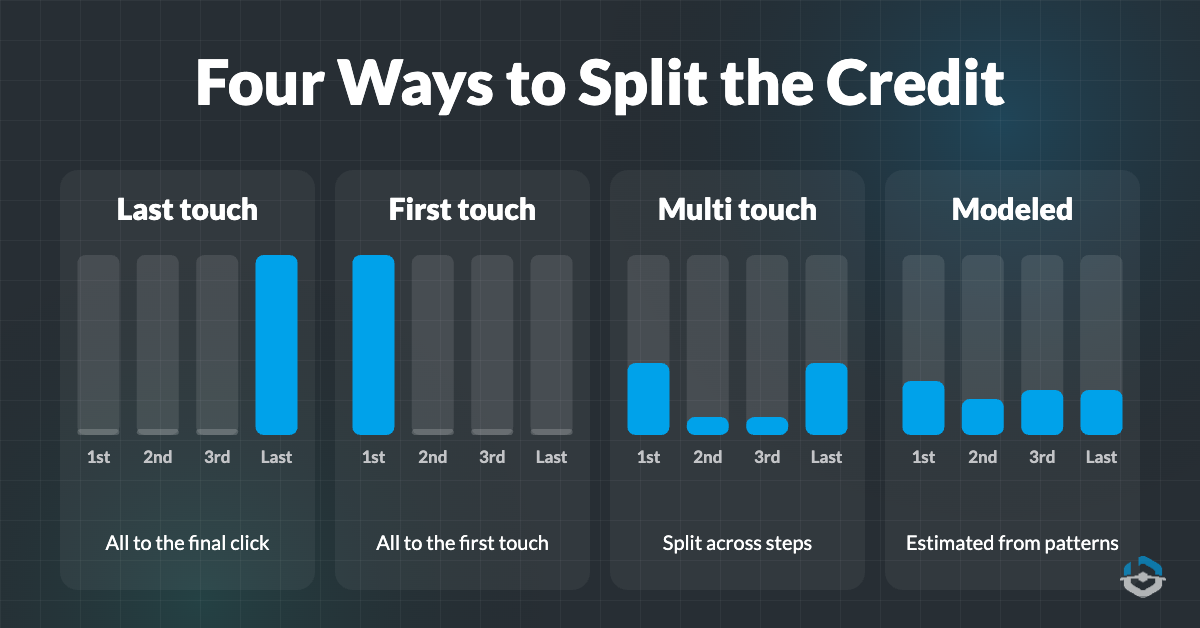
- Last touch. All credit to the final click before conversion. Simple, universally understood, and it makes retargeting and branded search look like heroes while ignoring everything that created the demand.
- First touch. All credit to the first interaction. The mirror image problem. Great for proving prospecting works, useless for knowing what closed.
- Multi touch. Credit split across several touchpoints, either evenly or weighted toward the first and last. Closer to reality, harder to explain, and it needs clean data across every channel to mean anything.
- Modeled or media mix. Statistical estimates of channel contribution based on spend and outcome patterns over time. Useful at large budgets. Not much help when a dealer principal wants to know about last month.
The model matters less than the data quality underneath it. A beautiful multi touch model running on three channels of partial data will lie to you with more confidence than a crude last touch model running on complete data.
Pick the simplest model your client will trust, then spend your effort on the inputs.
Pick the window before you argue about the model
Most attribution arguments are window arguments wearing a costume. The attribution window is how far back a platform will look for a touchpoint when something converts. Change the window and the same campaign, on the same model, reports a different number.
Set it against the real buying cycle, not against whatever the platform defaults to. A $40 impulse buy and a $40,000 vehicle do not deserve the same lookback. When a considered purchase gets measured on a one-day view window, the ads at the top of the funnel will always look like they did nothing, and someone will eventually propose cutting them.
Three questions settle it faster than a meeting:
- How many days pass between first ad exposure and purchase for this client, typically?
- Does the platform actually let you set that window, or is it capped?
- If it is capped, what other evidence covers the gap?
That third question is the one that matters. The answer is usually no, the platform will not let you. Which means the gap has to be filled somewhere else, and that somewhere else is the sold data. More on that shortly.
Tired of four dashboards taking credit for one sale?
BuyerBridge matches a client’s real sold report against ad exposure on Meta, TikTok, Snapchat, Pinterest and Reddit from a single upload, then reports it in one place with your agency’s name on it. See a real matchback run on a live account in 30 minutes.
Where attribution data actually comes from
Every marketing attribution number traces back to one of three sources, and knowing which one you are holding tells you how much weight it can carry.
Platform-reported conversions. The channel saw the click or the view, then saw a matching event fire on the site. Quick, free, and blind to everything happening on the other five channels. Fine for optimizing a campaign. Weak as proof.
Site event data. Your own record of what people did after the click. This is where you find out that a channel driving cheap traffic is driving nobody who reaches a product page. EventFlow handles this layer for BuyerBridge partners: one piece of code in the header that captures high-intent actions like form fills, widget clicks and vehicle detail page views, then shares those events back out to every connected ad platform at once. It is also what keeps vehicle-level retargeting alive after Meta removed custom audience building from its own tools.
Business outcome data. The CRM export, the sold report, the closed deal list. This is the only source the client already believes. It comes from their own system. It is also the one most agencies never connect, which is exactly why connecting it is worth so much.
Rank them by how much argument they end. Platform numbers start arguments, site data narrows them, outcome data finishes them.

Attribution when the sale happens in person
Most real money still closes somewhere a pixel cannot follow. A showroom, a phone call, a service lane. If the conversion event lives in the client’s building rather than on their website, no amount of model tuning will find it.
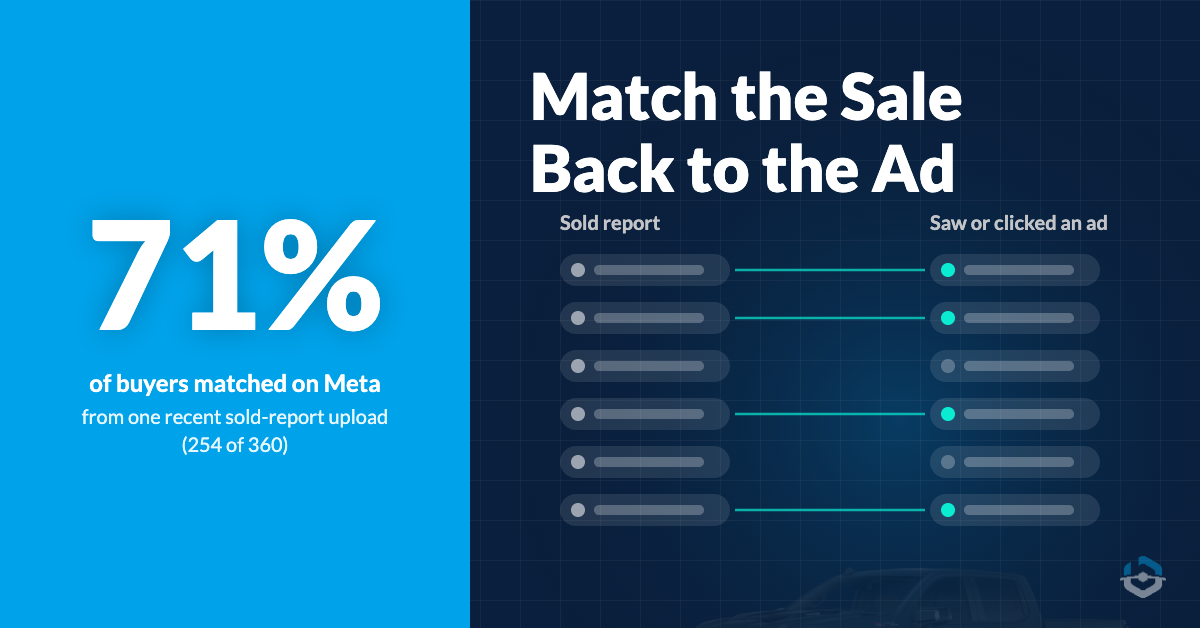
Matchback is the fix. You take the client’s sold report, match those buyers against people who saw or clicked the ads, and get a count of sales that had real ad exposure behind them. With BuyerBridge that is one CSV upload matched against Meta, TikTok, Snapchat, Pinterest and Reddit at the same time, instead of logging into each platform and uploading the same file five times. Match rates on Meta in platform data have run 71 percent and 68 percent on recent uploads, which is a much better answer than a dashboard guess. Google handles the same idea differently, matching on a click identifier your form captured rather than on customer records, which Google covers in its guide to offline conversion imports.
There is a version that needs no upload at all. Influence Sales reads the inventory feed: when a vehicle disappears from the feed it is treated as sold, and if that VIN had spend and clicks behind it, it counts. No CRM export, no waiting on the client to send a file on the third of the month. For the end-to-end loop from spend to sale, see closed loop attribution. The full upload mechanics live in the guide to offline conversion tracking.
Put a benchmark beside the count and the conversation changes shape. Industry average cost per vehicle sale runs around $600 by NADA and Digital Dealer figures. BuyerBridge partners typically target closer to $200. That comparison lands with an owner in a way that a cost per click never will.
Cross channel marketing attribution across six channels
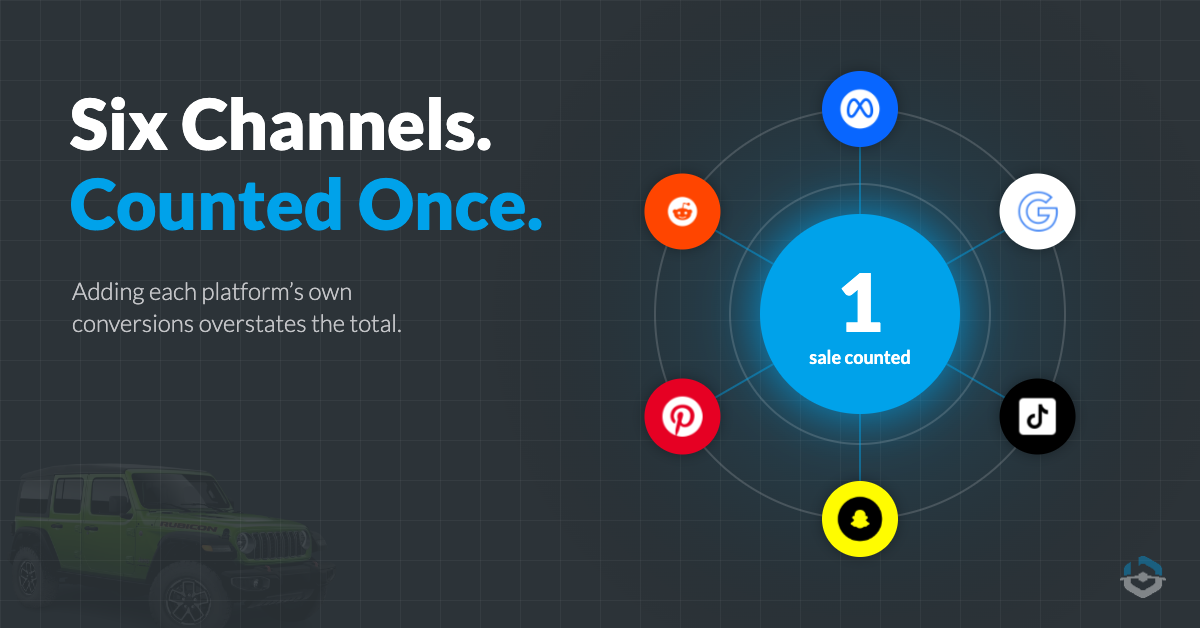
Cross channel attribution is where the double counting problem gets solved or ignored. Run Meta, Google, TikTok, Snapchat, Pinterest and Reddit for one client and each platform will report the sale it thinks it caused. Sum those reports and you will produce a number larger than the client’s actual sales, which is the fastest way to lose credibility in a review meeting.
One reporting layer above the platforms fixes it. Pull spend and results from all six into a single view, then reconcile against the client’s own outcome data instead of against each platform’s self-report. BuyerBridge does this through Campaign Management, where every channel and every client account lives in one dashboard, and through the matchback, which counts each sale once no matter how many channels touched it. The full method lives in the guide to cross channel attribution without the double counting.
Four rules keep cross channel numbers honest:
- Never add platform-reported conversions together. Overlap is guaranteed and unmeasured.
- Reconcile to one source of truth. The client’s sold or closed report, not the sum of dashboards.
- Report deduplicated counts, then channel contribution separately. One total, then the story behind it.
- Write down the assumptions. A documented method you can defend beats a precise number you cannot.
If you are pitching a prospect and want a read on their market before any of this exists, the free MarketAnalyzer report gives suggested spend by channel for their area in a couple of minutes.
Single touch vs multi touch vs matched to sold data
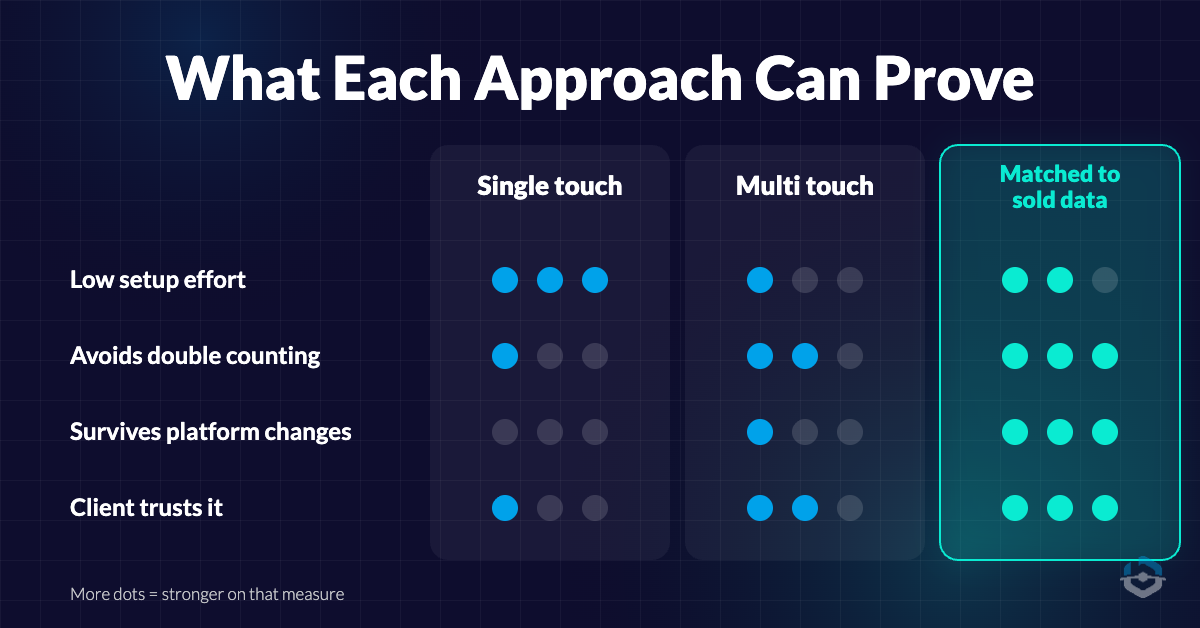
Three approaches, three very different levels of effort and trust. Pick based on what the client will believe, not on what sounds most sophisticated.
| Question | Single touch | Multi touch | Matched to sold data |
|---|---|---|---|
| What it credits | One click | Several touchpoints | Actual closed sales |
| Setup effort | None, it is the default | High, needs clean cross channel data | One file, or none with feed based |
| Double counting risk | High across channels | Medium, depends on the join | Low, each sale counted once |
| Survives a platform change | No | Partly | Yes, the sold report is yours |
| Client belief | Low, they know it is the platform | Mixed, hard to explain | High, it is their own data |
| Best used for | In-platform optimization | Budget allocation | Renewals and reviews |
Use single touch to steer campaigns day to day. Bring the matched numbers to the meeting where the retainer gets decided.
Why agencies choose BuyerBridge
Why Agencies Choose BuyerBridge
Attribution is where an agency either proves its worth or gets compared on price. Here is what agencies get:
- One CSV matched against Meta, TikTok, Snapchat, Pinterest and Reddit in the same session, not five separate uploads.
- Influence Sales, which counts sales from inventory feed movement with no CRM export required.
- EventFlow, one header script that captures high-intent site actions and feeds every connected platform.
- Vehicle-level custom audiences maintained through the API after Meta removed that capability from its own tools.
- Meta, Google, TikTok, Snapchat, Pinterest and Reddit reported from one dashboard.
- White-label reports that carry your agency’s name, with Influence Sales available as a report widget.
- VINFlow spend caps, so the budget behind those sales was distributed rather than concentrated.
- A library of pre-built Playbooks, so acting on what the attribution tells you takes minutes.
Being straight about it: no attribution method is perfect, and anyone selling you certainty is selling you something. Matching real sold data against real ad exposure is simply the least wrong answer available, and it is the one clients already trust.
Report it so the client believes it
A correct number delivered badly still loses the meeting. The report is where marketing attribution either becomes a decision or becomes a slide nobody reads.
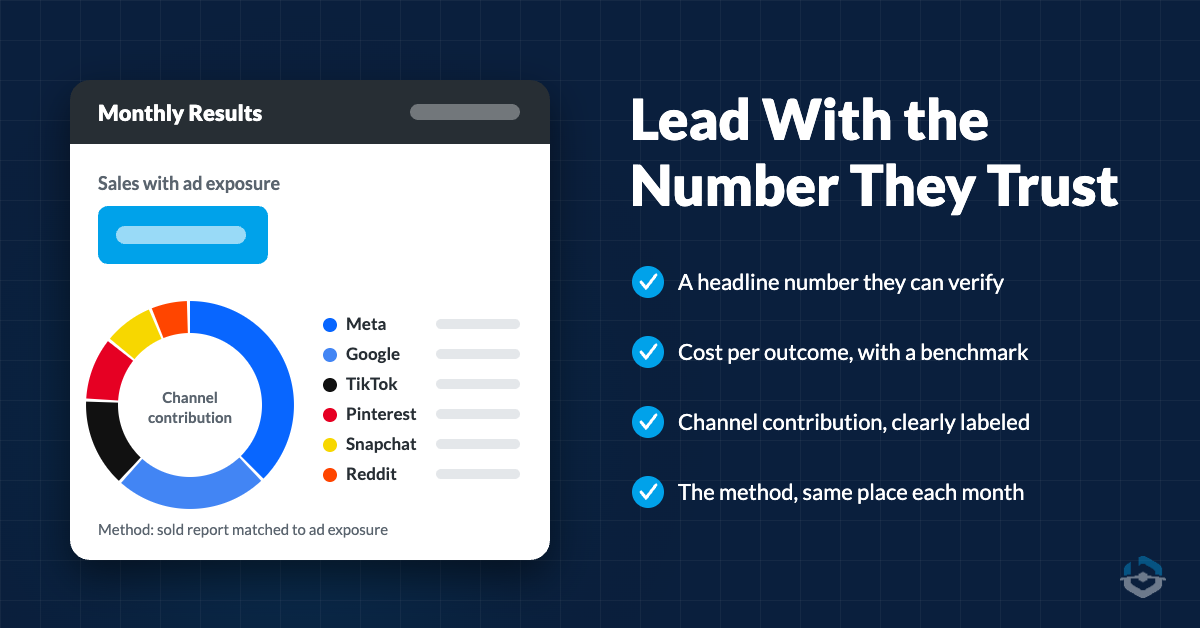
Lead with the outcome the client cares about, which is sales or qualified leads, not impressions. Put the channel breakdown underneath as explanation rather than headline. State the method in one sentence somewhere visible. A client who understands how you counted will defend your number for you when their boss questions it.
Then keep the format identical every month. Changing the layout, the window, or the model between reports is how a good quarter gets read as a bad one.
Four things every attribution report should carry:
- One headline number the client’s own system can verify.
- Cost per outcome, next to a benchmark that gives it meaning.
- Channel contribution, clearly labeled as contribution rather than as separate totals.
- The method, in a sentence, in the same place every month.
If you are building these by hand across several platforms, that is a solved problem. A white label reporting tool pulls every channel into one branded PDF, and the same numbers can be scheduled to send on their own.
A monthly marketing attribution routine
Marketing attribution fails from neglect far more often than from bad math. Put these five steps on the calendar and the quarterly review stops being a scramble.
- Agree the definition on day one. What counts as a conversion, over what window, measured how. In writing, before anything runs.
- Check the site event data monthly. A broken pixel found in month one costs a week. Found in month four it costs the account.
- Run the match at the start of each month. One upload against every channel, or let the feed-based count run on its own.
- Reconcile before you report. Compare the matched total against the client’s own numbers and resolve the gap before they find it.
- Act on it. Shift budget toward what the matched data credits, then check whether the shift held next month.
Do that for two quarters and the renewal conversation changes from defending a spend to planning the next one. It is the same shift covered in the guide to scaling an agency without adding headcount, and it pairs with budget pacing, which makes sure the money you are proving out actually went where you promised.
Frequently asked questions
What is marketing attribution?
Marketing attribution is how you assign credit for a conversion to the ads and touchpoints that influenced it. A buyer might see a video ad, search the brand, click a retargeting ad, and then purchase, and attribution decides how much credit each step earns. It requires three things: visible touchpoints across every channel, a visible conversion, and a reliable way to connect the two.
Why did our reported conversions drop in 2026?
Meta narrowed its attribution twice. On January 12, 2026, Meta retired its 7-day and 28-day view windows, leaving one day. In late March 2026 only direct-to-site clicks continued to count as clicks, while likes, shares and saves became views under that same one-day window. Considered purchases rarely happen within a day of an ad view, so reported results fell while actual results did not change.
Which attribution model should an agency use?
Use the simplest model the client will trust, then put your effort into data quality. Last touch is easy to explain and fine for steering campaigns day to day. Multi touch allocates budget more fairly but needs clean data on every channel. For anything that closes in person, matching real sold records against ad exposure beats every model, since the client already believes their own system.
What is cross channel attribution?
Cross channel attribution measures results across every platform at once rather than reading each platform’s self-report. It matters since platforms cannot see each other, so adding their reported conversions together produces a total larger than the client’s real sales. The fix is to reconcile against one source of truth, usually the client’s closed sales report, and count each conversion once.
How do you attribute a sale that happens in a showroom?
Match the sale back to ad exposure after the fact. Upload the client’s sold report and match those buyers against people who saw or clicked the ads. BuyerBridge runs one CSV against Meta, TikTok, Snapchat, Pinterest and Reddit at the same time. Influence Sales does it with no upload at all by treating a vehicle that leaves the inventory feed as sold when that VIN had spend and clicks behind it.
What is an attribution window and how long should it be?
The attribution window is how far back a platform looks for a touchpoint when a conversion happens. Set it against the real buying cycle rather than the platform default. A same-day impulse purchase and a vehicle purchase should not share a window. When the platform caps the window shorter than the actual cycle, cover the gap with matched sold data instead of accepting the shorter number.
The bottom line
Marketing attribution is the argument you make for why the retainer should continue, and platform dashboards will not make that argument for you, especially after a year in which two of them quietly changed the rules. Agree the definition early, watch the event data, match against the client’s own sold records, and report the same way every month.
Want to see a real matchback run against a live account? Book a 30-minute demo. If you want the mechanics of connecting sales that close offline, start with offline conversion tracking.
Written by Emily Leasure, Product Marketing Manager at BuyerBridge. Connect on LinkedIn.